Sunday, September 25, 2005

Saturday, September 24, 2005

本田的車間通信技術 還將應用於新一代AFS等領域

http://china5.nikkeibp.co.jp/china/news/auto/auto200509060122.html

【日經BP社報道】
本田日前發佈了安全試驗車“Honda ASV-3”。在日本國土交通省推進的第3個ASV計劃中,利用車間通信提高駕駛安全性是一大主題。“Honda ASV-3”通過在攝像頭及雷達獲取到的資訊的基礎上增加車間通信,實現了對車輛及行人的預測功能、提高了安全性。

  車間通信使用ETC(自動收費系統)等也在使用的5.8GHz頻帶,可在車輛之間交換車輛的位置、速度及車型等資訊。最大輸出功率為10mW,可通信距離在市區時雖然只有大約200m,在郊區則最長可達到800m左右。主要通過GPS(全球定位系統)獲得的位置資訊來判斷車輛的相互位置、起到防衝撞作用。不過,GPS的檢測精度並不是太高,“在市區有時會出現大約10m的誤差”(會場解說員),因此,為了判斷正確的位置,還配套使用了攝像頭及雷達等。

  “Honda ASV-3”除預防衝撞外,還在AFS(自適應前燈系統)以及調整彎道駕駛速度等方面應用了車間通信。另外,當無法使用手機進行緊急通報時,也可利用車間通信。此次公開的主要車間通信功能如下。(記者:田知本 史朗)

●右轉彎時提供對向車輛資訊的系統:除位置及車速外,還可交換“行駛方向”資訊。摩托車還可利用顯示器及聲音傳達接近車輛的情況。

●十字路口暫時停車及再起動輔助系統:可交換位置資訊,並在再次起動時對安全確認進行輔助。十字路口的資訊通過導航儀顯示,而標識及標示則通過攝像頭識別。

●正面衝撞事故防止輔助系統:除位置及車速外,還可交換“操舵角”資訊,當有可能與對向車輛的行車路線衝突時,就會發出警告。除向車輪施加反方向的力(使用助力方向盤)外,還會振動內置有致動器的油門踏板、向駕駛員發出警告。

●彎道進入速度輔助系統:可獲取前方車輛的位置、車速資訊。通過導航儀資訊獲得彎道彎曲率、自動實施減速。

●車間維持輔助系統:可獲得前方車輛及隨後的減速資訊。當超過速度過快時,便會通過聲音發出警告。同時使用雷達。

●新一代AFS:在交換位置資訊後,如果沒有對向車輛,便會切換至高光燈。高光燈自動切換裝置由美國Gentex公司等銷售,此前則是通過攝像頭來識別前方車輛及對向車輛。

●行人檢測系統:行人也帶有通信裝置的人車通信。為了提高位置資訊的精度,配套使用了攝像頭。

●車間通信器。頻率為5.8GHz,輸出功率為10mW。傳輸速度為4.096Mbps。在進行人車通信實驗時,內置有乾電池,並為行人使用進行了改進。

●車間通信用天線。
  

本田發佈先進安全試驗汽車及摩托車

【日經BP社報道】

http://china5.nikkeibp.co.jp/china/news/auto/auto200509060121.html
  本田2005年9月2日發佈了面向日本國土交通省推進的“ASV-3項目”的安全試驗車“Honda ASV-3”。該車除配備了項目主題的車間通信功能外,還配備有利用攝像頭及雷達的接近車輛及行人檢測系統,以及發生事故時的緊急通報功能等。ASV不僅開發了汽車,而且還開發了配備後方攝像頭的摩托車。

  車間通信系統除可在汽車之間外,還可與摩托車及行人交換位置資訊。通過在導航儀上顯示正在接近的車輛的狀況、利用聲音警告正在接近,可以防止攝像頭與雷達難以發現的事故,比如,經過路口及右拐時與衝出路口的其他車輛相撞。

  另外,還配備有使用CCD攝像頭、鐳射雷達、毫米波雷達的行人檢測系統,以及檢測到橫穿馬路的行人後發出警報的功能。

  該車具備發生事故時發送緊急通報的功能,即可使用手機向處理中心發送車輛位置、車型、安全氣囊的工作狀況及駕駛員的狀況等資訊。比如,可發送事故發生前5秒內及事故發生後10秒內的駕駛員的影像,以及通過座席下的生物感測器檢測到的心跳和呼吸數據。

  本田計劃參加日本國土交通省實施的“ASV-3”檢測實驗(2005年7月4日~10月28日),以及預定在北海道舉行的公開實驗(10月12日~13日)。(記者:林 達彥)

Advance Pre-Safe:賓士汽車S-class的新安全系統

作者:駐芝加哥科技組 現職:駐芝加哥科技組
文章來源:駐芝加哥科技組
發佈時間:94.09.22

置於車輛前方的感測器可以偵測出危險狀況,更可以操作剎車系統。

為了避免猛撞前面的汽車而損毁一部價值九萬美元的豪華汽車,賓士車廠在2007年S級轎車的設計上增加了一種類似千里眼的安全系統,這種定名為 Advance Pre-Safe的安全系統可以預測甚至防止可能發生的撞擊。它利用電達探測前端道路的狀況,當它查覺到前面有障礙物的時候就會發出警報,如果駕駛人沒有 注意到警示,而S-class判斷撞擊無法避免的時候,Pre-Safe系統就會為最壞的情況做準備。這時,剎車會運作、座椅帶子會拉緊、車邊和車頂的窗 子都會關緊、移動的駕駛座會回歸它原來的位置。即使駕駛人踩剎車踩的太輕微,安全系統也會增加到足夠的力量使車輛停下來。以前的賓士Pre-Safe安全 系統則只有在駕駛人突然轉彎或是猛踩剎車,眼看即將發生車禍的時候才會拉紧座椅帶子以及移動seatbacks歸位。

一般人可能因為S-class太貴買不起,但是至少被後面車輛追撞的機會減少了。

Friday, September 23, 2005

iSpace seminar

> From: Polly Huang [mailto:phuang@cc.ee.ntu.edu.tw]
> Sent: Thursday, September 22, 2005 5:23 PM
> To: group@nslab.ee.ntu.edu.tw;
> lab336_mll@mll.csie.ntu.edu.tw; ispace-pi@nslab.ee.ntu.edu.tw
> Subject: ispace seminar 2005 fall

Hi all,

hope we are all charged up and ready for the new semester.
Here are couple things to note about iSpace seminar.

1. We'll cancel iSpace seminar that is supposed to be on this Friday. The new iSpace seminar time for the semester is set to Tuesday noon 12:30-2:00. We'll begin from next Tuesday 9/27.

2. Bob has kindly agreed to take over the duty of coordinating the seminar. (Thanks, Bob!)

cheers,

-Polly
-----------------------
- I have reserved CSIE 310 (the original seminar room) for the ispace seminar on Tuesday noon (12:30 ~ 2:00).

- Given that current listed papers are more focused on user interfaces (papers from CHI 2006), please feel free to add any other papers of your interest in the seminar and we can push these CHI papers back.

Thanks,

Hao

Thursday, September 22, 2005

Postdoctoral Post at Oxford University

Postdoctoral Research Assistant in Mobile Robotics.

Applications are invited from suitably qualified candidates for the above position. This post is available initially for 12 months with an anticipated continuation of up to three years.

The successful candidate will have a doctoral degree in estimation, mobile robotics, computer vision or a closely related area in computer science and an understanding of the Simultaneous Localisation and Mapping (SLAM) problem and contemporary approaches. You will also need to have a strong familiarity with optimisation techniques especially those commonly used for tasks in computer vision. Excellent proven ability in software writing and debugging skills in C++ and Matlab, demonstrated ability to work as part of a team, experience in validation of algorithms using real data and the ability to work to deadlines are essential. A background in computer vision/robotics, a knowledge of systems engineering and a desire to to work in an energetic group of researchers are highly desirable.

The starting salary will be in the RA1A scale £19460 - £23643

Further particulars may be obtained from www.eng.ox.ac.uk or Mr C J Scotcher, The Senior Administrator, University of Oxford, Department of Engineering Science, Parks Road, Oxford, OX1 3PJ, or by email to administrator@eng.ox.ac.uk ; to whom written applications should be made enclosing a curriculum vitae and the names and addresses of two referees.

Please quote DF05066 in all correspondence.

The closing date for applications is 30th September 2005

Robotics Faculty position at Duke University

ASSISTANT OR ASSOCIATE PROFESSOR
DEPARTMENT OF MECHANICAL ENGINEERING AND MATERIALS SCIENCE PRATT
SCHOOL OF ENGINEERING

The Pratt School of Engineering at Duke University is currently undergoing a period of significant growth in human and physical resources driven by a highly successful Capital Campaign and a transforming endowment to name the Engineering school.

The Department of Mechanical Engineering and Materials Science invites applications for tenure-track faculty positions. A tenure- track appointment at the Assistant or Associate Professor level is anticipated, but appointments at the Full Professor level with tenure are available for exceptional applicants. Applications are invited from candidates with research interests in one of the following areas: nano-mechanics, autonomous vehicles and robotic systems, and energy technology including traditional and alternative energy sources. Applications will also be accepted for allied mechanical engineering disciplines such as vehicle dynamics, nonlinear dynamics and control, MEMS devices, sensor technology, small and micro-scale propulsion systems, thermal sciences, aerodynamics and aeroelasticity.

Successful candidates are expected to establish a vibrant research program, obtain competitive external research funding, and participate actively in teaching at both the undergraduate and graduate levels.

Applicants should submit a cover letter describing their research interests and qualifications, a curriculum vitae, and the names and addresses of three references. Please submit your application to mems- search@mems.duke.edu as a PDF (preferred) or Word file attached to your email. Duke University is an Affirmative Action/Equal Opportunity Employer.

Wednesday, September 21, 2005

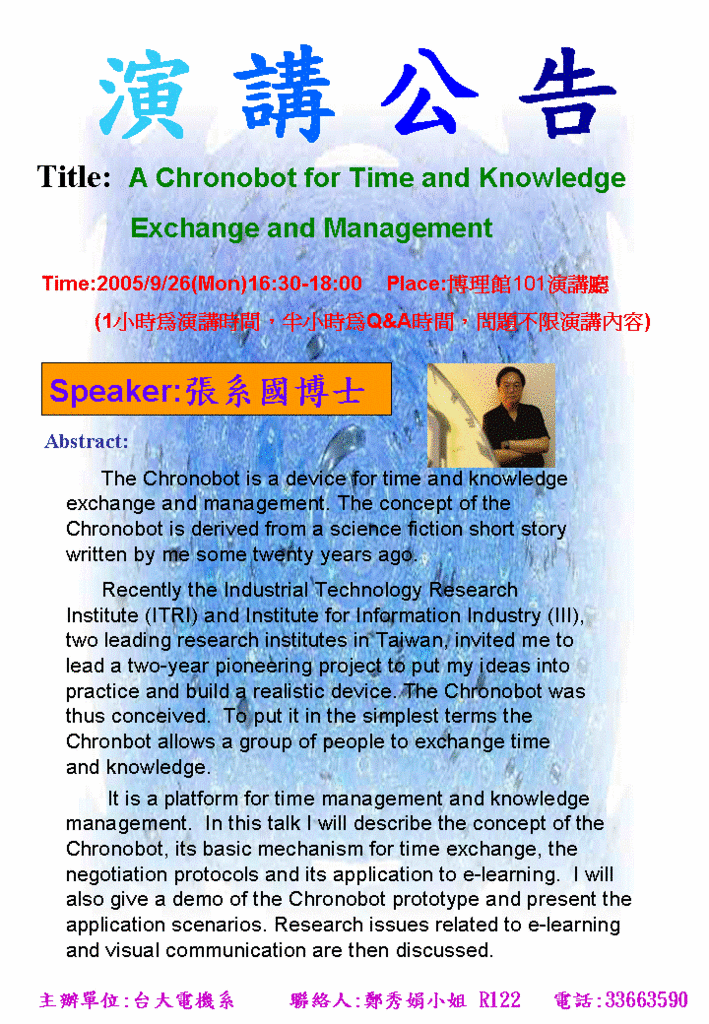
94/9/26(一)4:30-6:00PM張系國博士演講訊息

Title: A chronorobot for time and knowledge exchange and management.
Next Monday, 4:30pm, in 博理館101演講廳.

Tuesday, September 20, 2005

CMU VASC seminar: Pedestrian Detection with Thermopiles and Short Range Radars

Dirk Linzmeier
DaimlerChrysler

Abstract:
Automotive pedestrian protection systems will be introduced in the EU in short term to reduce the number of accidents and injury fatalities. As with any safety issue, a comprehensive approach comprising both active and passive safety elements should be followed. This is also valid for pedestrian protection, where it has been shown that next to purely passive measures, accident avoidance systems e.g. the Brake Assist have significant potential to reduce injury severity. Passive safety short term solutions can be contact sensor systems that trigger raisable engine hoods. However, an important enabler for a future pedestrian protection system is a suitable, low-cost, environment-friendly sensing technology for pedestrian detection, supported by a fast and reliable algorithm for object localization.
This talk discusses such an innovative approach for pedestrian detection and localization, by presenting a system based on two short range radars and an array of passive infrared thermopile sensors, aided with probabilistic techniques for detection improvement.
The two short range radars are integrated in the front bumper of the test vehicle. They are able to observe and track multiple targets in the region of interest. However, one difficulty is to distinguish between pedestrians and other objects. Therefore, a second sensor system is required to classify pedestrians reliably. This system consists of spatial distributed thermopile sensors which measure the object presence within their respective field-of-view independently. These measurements are then validated and fused using a mathematical framework. Thermopiles are excellent to detect the thermal radiation emitted by every human. However, a robust signal-interpretation algorithm is mandatory. In this work a statistical approach combining Dempster-Shafer theory with occupancy-grid method is used to achieve reliable pedestrian detection.
Thermopile and radar sensors use independent signature-generation phenomena to develop information about the identity of objects within the field of view. They derive object signatures from different physical processes and generally do not cause a false alarm on the same artifacts. The integration of the sensor readings from the radar and thermopile system is conducted using a unifying sensor-level fusion architecture.

Bio:
Dirk Linzmeier received the Dipl.-Ing. degree in electrical engineering from the University of Ulm, Germany, in 2003 and is currently working toward the Ph.D. degree. He is working on a pedestrian detection system for automotive applications based on radar and thermopile sensors at the DaimlerChrysler research center in Ulm, Germany. His research interests include data fusion methods, object tracking, infrared detection systems and environmental sensing simulations. Mr. Linzmeier is also the author of several papers regarding pedestrian detection.

CMU RI Thesis Oral: Assistive Intelligent Environments for Automatic Health Monitoring

Daniel Wilson
Robotics Institute, Carnegie Mellon University

As people grow older, they depend more heavily upon outside support for health assessment and medical care. The current healthcare infrastructure in America is widely considered to be inadequate to meet the needs of an increasingly older population. One solution, called aging in place, is to ensure that the elderly can live safely and independently in their own homes for as long as possible. Automatic health monitoring is a technological approach which helps people age in place by continuously providing key information to caregivers.

In this thesis, we explore automatic health monitoring on several levels. First, we conduct a two-phased formative study to examine the work practices of professionals who currently perform in-home monitoring for elderly clients. With these findings in mind, we introduce the simultaneous tracking and activity recognition (STAR) problem, whose solution provides vital information for automatic in-home health monitoring. We describe and evaluate a particle filter approach that uses data from simple sensors commonly found in home security systems to provide room-level tracking and activity recognition. Next, we introduce the "context-aware recognition survey," a novel data collection method that helps users label anonymous episodes of activity for use as training examples in a supervised learner. Finally, we introduce the k-Edits Viterbi algorithm, which works within a Bayesian framework to automatically rate routine activities and detect irregular patterns of behavior.

This thesis contributes to the field of automatic health monitoring through a combination of intensive background study, efficient approaches for location and activity inference, a novel unsupervised data collection technique, and a practical activity rating application.

A copy of the thesis oral document can be found at http://www.cs.cmu.edu/~dwilson/papers/thesis.pdf.

Monday, September 19, 2005

i-space seminar meeting time

Hi Folks,

Below is a messenage from Prof. Chu. Please tell me your available time. Thanks,

-Bob

Hi all,

We probably want to set up a new time for i-space seminar. For this week, it would be great that you can ask your students about possible time slots for the seminar. Given the large number of students, we may be able to use lunch hours (Monday ~ Friday 12:30 ~ 2 pm) when classes are not scheduled.

It would be great that you can let me know good meeting time at the end of this week.
Thanks,

Hao-hua Chu

My talk this Wednesday

sorry for the delay...

I will be talking about the paper "Learning Activity-Based Ground Models from a Moving Helicopter Platform" and its related topics.

Saturday, September 17, 2005

CMU VASC Talk: Shedding Light on Scattering

Srinivas Narasimhan
CMU
Monday, September 19, 2005

Abstract: This is really two talks combined into one. The vision part will appear in ICCV'05 and the graphics part appeared in Siggraph'05.

In the first half, I will explore the effects of active illumination in scattering media like underwater, atmosphere and fluids. Active illumination is often used by underwater vehicles and divers to explore and inspect underwater scenes, automotive manufacturers in designing headlights to see through fog and even microscopic imaging of biological tissues and organisms. In all these cases, the appearances of the scenes are corrupted due to scattering by the medium and hence, traditional structured light approaches fail completely. I will present physics based methods to make structured light techniques successful in scattering media. In addition, I will show surprising results that could not have been computed using traditional methods even in clear air (depth from photometric stereo, reconstructing mirrors and seeing through milk).

In the second half, I will show how to render scattering effects in real-time, considering even more complex near-field lighting from point sources. The core result here is that the expensive integral of a 5D scattering function that needs to be computed for every viewing and surface illumination direction is factored into a product of an analytic function and a lookup of a 2D pre-computed function. This allows us to use standard textures and graphics hardware to render realistic effects at around 20-30fps. The algorithm is very simple to implement, can be used extensively in games for which third-party developers have already created Maya plugins of our algorithms.

Wednesday, September 14, 2005

The New York Times: Robotic Vehicles Race, but Innovation Wins


Robotic Vehicles Race, but Innovation Wins
By JOHN MARKOFF
Published: September 14, 2005

FLORENCE, Ariz. - Cresting a hill on a gravel road at a brisk 20 miles an hour, a driverless, computer-controlled Volkswagen Touareg plunges smartly into a swale. When its laser guidance system spots an overhanging limb, it lurches violently left and right before abruptly swerving off the road.

More...

CMU Thesis Proposal: Geometrically Coherent Image Interpretation

Derek Hoiem
Robotics Institute, Carnegie Mellon University

Abstract: Objects in the world interact and are constrained according to their 3D geometry. Thus, inference of 3D geometry provides a natural interface for relating objects and performing actions such as navigation. We propose a simple class-based representation for 3D geometric information, in which we estimate 3D orientations from a single image using appearance-based models. With knowledge the scene's geometry, we can improve image understanding algorithms, including object detection, material labeling, and scene recognition. We focus on improving object detection using our geometric context and estimates of the camera parameters. Rather than simply using estimated geometry as features into a subsequent classification system, however, we propose to determine a coherent hypothesis that enforces the strong geometric relationships among the individual object and surface hypotheses. We develop a probabilistic formulation for encoding the relations of different types of scene information and describe inference algorithms for posing queries about the scene.

Further Details: A copy of the thesis proposal document can be found at http://www.cs.cmu.edu/~dhoiem/hoiemproposal.pdf.

Tuesday, September 13, 2005

Group meeting presentation schedule

week 1. Any
week 2. Jim
week 3. Nelson
week 4. Bright
week 5. Eric
week 6. ChiHao
week 7. Vincent
then repeat.

Please post your talk title and the related links or pdf files 3 days before the talk.

CNN video: Robot rescuers

CNN's Daniel Sieberg looks at robots used to check for survivors in hurricane-ravaged areas. (September 12). Click here.

Monday, September 12, 2005

Group meeting

Hi Folks,

Come to our group meeting this Wednesday.

Venue: CSIE 524
Date : Wednesday, September 14
Time : 11:00 AM

Any, could you please post the title of your talk and related materials? People can read those papers/books in advance.

Thanks,

-Bob

MIT thesis defense: Learning Task-Specific Similarity

Speaker: Greg Shakhnarovich , CSAIL
Date: Tuesday, September 13 2005

The right measure of similarity between examples is important in many areas of computer science, and especially so in example-based learning. Similarity is commonly defined in terms of a conventional distance function, but such a definition does not necessarily capture the inherent meaning of similarity, which tends to depend on the underlying task. We develop an algorithmic approach to learning similarity from examples of what objects are deemed similar according to the task-specific notion of similarity at hand, as well as optional negative examples. Our learning algorithm constructs, in a greedy fashion, an encoding of the data. This encoding can be seen as an embedding into a space where a weighted Hamming distance is correlated with the unknown similarity. This allows us to predict when two previously unseen examples are similar and, importantly, to efficiently search a very large database for examples similar to a query.

This approach is tested on a set of standard machine learning benchmark problems. The model of similarity learned with our algorithm provides an improvement over standard example-based classification and regression. We also apply this framework to problems in computer vision: articulated pose estimation of humans from single images, articulated tracking in video, and matching image regions subject to generic visual similarity.

I have some questions

I want to ask Bob some questions, but it seems relevent to all of us, so I'm posting here.
1. What jobs can we do in this field?
    be a professor? work in a company? start a business?
    Also, let's say our group developed a technology for self-driving cars, and we want to start an automatic taxi service. Should we start a business or what?
2. Innovation vs. Integration
    There are lots of good technologies(papers) that could be, but are not made into profitable/beneficial products/services, so why aren't they? It seems that researchers keep inventing new stuffs, but they are not becoming products. Someone can make lots of (undeserved?) money just by reading their papers and integrating them into products.
3. Racism in America?
    I want to live in America (because of more space, cleaner air, more places to explore / things to do / job possibilities, better food, ...), but my dad says there'll be racism problems, especially for my kids. But I guess that if we are smarter or be better persons, people will treat us well enough. Besides, I think people are nicer there (according to movies and my personal experience).

Sunday, September 11, 2005

a good Conference, Robotics: Science and Systems

Online Proceedings are available here.

Projector-Camera Systems

http://www.procams.org/
Eric, check out the papers of Procams 2005.

-Bob

Saturday, September 10, 2005

How to download papers

These are the methods I know:

1. CiteSeer (has many computer-science papers, for free)
    http://citeseer.csail.mit.edu/cs

2. Google Scholar (google's index of online papers, most of them not free)
    http://scholar.google.com/

3. 台大圖書館's 電子資料庫 (has IEEE subscription, and more)
    http://dbi.lib.ntu.edu.tw/libraryList/
    如何使用

i-space summer retreat program.

Hi Folks,

You should attend this i-space summer retreat on Sep 15 &16. I will not attend the first day's program because I will attend 於9月15日上午舉行之『94學年度新進教師說明會』.

-Bob


Location CSIE 104
====================
9/15 Thursday

10:00 - 11:30 Activity overview from each lab (120 minutes)

Welcome note ... Hao Chu (5 minute)
Robot Lab overview ... Prof. Fu (10 minutes)
Vision lab overview ... Prof. Hung (10 minutes)
Agents lab overview ... Prof. Hsu (10 minutes)
Embedded Computing lab overview ... Prof. Yang (10 minutes)
Network lab overview ... Prof. Huang (10 minutes)
Ubicomp lab overview ... Prof. Chu (5 minutes)
Prof. KJ Lin talk (30 minutes)

12:00 - 13:00 Lunch

13:00 - 14:50 Session I: Localization (110 minutes)
(r1) "Inhabitant Tracking via Floor Load Sensors", Wen-Hau Liau, Robot lab (20 minutes)
(r2) "Real-Time Fine-Grained Multiple-Target Tracking on A Virtual Fab Architecture Based on Multi-Agents", Ching-Hu Lu, Robot lab (20 minutes)
(n1) "Energy Efficient Personal Asset Tracking", Hao, Network lab (20 minutes)
(u1) "Geta++: walking away with localization", Shun-yuan Yeh, Ubicomp lab (15 minutes)
(u3) "Adaptive WiFi localization: improving positioning accuracy under environmental dynamics", Yi-Chao Chen, Ubicomp lab (15 minutes)
(v1) "Improve WiFi Localization Accuracy Using Neighboring Information", Li-Wei Chan, Vision lab (20 minutes)

14:50 - 15:05 Tea break

15:05 - 16:45 Session II: System & Network (100 minutes)
(e1) "Parallel Processing on Multicore Processors for Multimedia Applications", Lin-Chieh Shangkuan, Embedded lab (20 minutes)
(e2) "Thermal Issues on Multicore Processors", Chung-Hsiang Lin, Embedded lab (20 minutes)
(n2) "BL-live", SY, Network lab, (20 minutes)
(n3) "Hotstreaming", Jerry, Network lab, (20 minutes)
(n4) "Skyqe", Cheng-Ying, Network lab (20 minutes)


==============
9/16 Friday

10:00 ~ 10:30 Robotics for Safe Driving, Prof. Wang (30 minutes)

10:30 ~ 12:00 Session III Context Awareness (90 minutes)
(a1) "iCare activity recognition", wintel & Brooky, Agents lab (15 minutes)
(a2) "A context-aware multi-agent system in emergency room", Skyish, Jih, 世偉, Agents lab (15 minutes)
(u2) "Dietary-aware dining table: tracking what and how much you eat", Toung & 婕妤, Ubicomp lab (15 minutes)
(u4) "Privacy camera", Edwin Teng, Ubicomp lab (15 minutes)
(u5) "The watchful watch & ring", Shin-jan Wu, Ubicomp lab (15 minutes)
(u6) "The recipe-writing kitchen", Ben Tian, Ubicomp lab (15 minutes)

12:00 ~ 13:00 Lunch

13:00 ~ 13:45 Session IV: Interaction & Agents (45 minutes)

(a3) "Active meeting, chihyuan & 昭瑋, Agents lab (15 minutes)
(a4) "Agent-based photo sharing system", (Dan, left, 郁欣), Agents lab (15 minutes)
(a5) "Virtual pets", (宣, 哲, salt), Agents lab (15 minutes)

13:45 ~ 14:00 Tea break

14:00 ~ 15:25 Session V: Vision (85 minutes)
(r3) "Self-Calibrating Vision-Based Driver Assistance System Incorporating Particle Filter under Various Lighting Conditions", Yi-Ming Chan, Robot lab (20 minutes)
(r4) "Region-Level Motion-Based Foreground Detection Using MRFs", Shih-Shinh Huang, Robot lab (20 minutes)
(v2) "Steerable Projector-Camera System for Interactive Multi-Resolution Display", 葉韋賢, Vision lab (15 minutes)
(v3) "Interactive Multi-Resolution Table", 賈義偉, Vision lab (15 minutes)
(v4) TBD, 張譽馨, Vision lab (15 minutes)

CNN: Backpack generates power from walking


Friday, September 9, 2005; Posted: 10:06 a.m. EDT (14:06 GMT)

WASHINGTON (Reuters) -- A backpack that converts a plodding gait into electricity could soon be charging up mobile phones, navigation devices and even portable disc players, U.S.-based researchers said on Thursday.

More...

Wednesday, September 07, 2005

NSC articles

衛星導航智慧車
作者: 王立昇 臺灣大學應用力學研究所
The html version. The PDF version.

電子貼身護士
作者:
游世安 臺灣大學電子工程學研究所
呂學士 臺灣大學電機工程學系
林啟萬 臺灣大學醫學工程學研究所
王堯弘 臺大醫院影像醫學部

Sunday, September 04, 2005

CMU Talk: Estimating Geometric Scene Context from a Single Image

Speaker: Alexei A. Efros

Humans have an amazing ability to instantly grasp the overall 3D structure of a scene -- ground orientation, relative positions of major landmarks, etc -- even from a single image. This ability is completely missing in most popular recognition algorithms, which pretend that the world is flat and/or view it through a patch-sized peephole. Yet it seems very likely that having a grasp of this "geometric context" of a scene should be of great assistance for many tasks, including recognition, navigation, and novel view synthesis.

In this talk, I will describe our first steps toward the goal of estimating a 3D scene context from a single image. We propose to estimate the coarse geometric properties of a scene by learning appearance-based models of \emph{geometric} classes. Geometric classes describe the 3D orientation of an image region with respect to the camera. We provide a multiple-hypothesis segmentation framework for robustly estimating scene structure from a single image and obtaining confidences for each geometric label. These confidences can then (hopefully) be used to improve the performance of many other applications. We provide a quantitative evaluation of our algorithm on a dataset of challenging outdoor images.

We also demonstrate its usefulness in two applications: 1) improving object detection (preliminary results), and 2) automatic qualitative single-view reconstruction ("Automatic Photo Pop-up", SIGGRAPH'05).

Joint work with Derek Hoiem and Martial Hebert at CMU.

Saturday, September 03, 2005

Group meeting

Hi Folks,

Let's have our first group meeting this Wednesday, 11AM at Room 524. Please DO let me know if you can not attend it.

Thanks,

-Bob

Tuesday, August 30, 2005

科技會議定方向 六大新興科技

作者:科技政策中心 現職:科技政策中心
文章來源:經濟日報 94/08/19 工商時報 94/08/19
發佈時間:94.08.26
行 政院二○○五年產業科技策略會議圓滿閉幕,在科技顧問等專家及產官界代表的討論下,預算投入至少16億元經費,推動研發包括軟性電子1億元、智慧型車輛 5億元、智慧化生活空間3億元、RFID 2億元、科技化服務業旗鑑計畫5億元等六項重點發展方向。其中奈米科技部分,已有奈米國家型計畫執行中,從2003年起六年內投入200億元。今年最大的 不同是,所有議題都與生活習習相關,行政院長謝長廷指示公部門應率先示範採用SRB定調的六大新興科技,以帶動民間投入意願。

老人輔具研發 一年補助兩億

老人輔具研發 一年補助兩億
作者:科技政策中心 現職:科技政策中心
文章來源:自由時報 94/08/19
發佈時間:94.08.26
國科會宣布將以一年兩億元的規模,補助學界進行「前瞻優質生活環境科技」的跨領域研發計畫,鼓勵科技和人文學者組成團隊並結合產業界,以研發出十五年後老齡化台灣所需的科技產品。因老齡化是科技社會普遍趨勢,老人照護和輔具的市場是被看好的明星產業之一,以期打造台灣優質生活環境。

Friday, August 26, 2005

Free tickets for 《亞太創新‧創業論壇》

Hi Folks,

If you are interested in this event, let me know as soon as possible! It is free for three of my students!

-Bob

------------------------------------
王教授,您好:
  
今日由廣達得知王教授將參與9月1日《亞太創新‧創業論壇》.時代基金會促成本會議,期待更多的學術及學研交流,因此特別提供三個免費的學生名額給您的研究生,煩請他們填寫完成附加檔案中之報名資料,於8月28日前傳真至時代基金會給李小姐.機會非常難得,請王教授邀請學生一同與會.

聯絡方式 傳真:2545-3523 電話:2545-3525 李小姐

時代基金會 敬啟
----------------
時間:九月一日(週四) 9:00 ~ 17:00
地點:台北君悅大飯店三樓宴會廳

詳見 http://www.businessweekly.com.tw/event/2005apiec/index.php
一場世界級大師的智慧論壇, 10堂科技成果及商業應用分享,
結合人類福祉與無限商機, 由來自全球科技智慧搖籃-麻省理工MIT CSAIL實驗室
三位世界級大師及七家全球科技標竿企業,
分享最新「殺手級」技術突破,亞洲首度發表!

CMU VASC Talk: Towards Intelligent Video Solutions

Xiaoming Liu, Jens Rittscher, Nils Krahnstoever
Visualization and Computer Vision
GE Global Research

ABSTRACT
The Visualization and Computer Vision Group at GE Global Research serves a large number of GE businesses in areas such as medical image processing, industrial inspection, and intelligent video systems. We will give a brief overview of our group and will then focus on security related projects. We will motivate specific research needs that originate from our collaboration with GE Security. The objective of the ongoing research is to extend the functionality and robustness of the intelligent video product line currently offered by GE.

The technical presentation will include auto-calibration, segmentation of crowds, and people counting. The talk will present an approach to reliably estimate camera parameters form person detections. Furthermore we will illustrate that this calibration information effectively enables model-based segmentation of crowds and people counting.

Thursday, August 25, 2005

About the Group Meeting

I would like to arrange a day for the group meeting, say from Monday to Wednesday, temporarily. Here you can share what you are learning, what you are observing about a problem, how it affects you, or even offer a better solution. Don't worry about this since you will only become the speaker after you get ready.

Our adviser, Bob, will give us a guide to robotics at the first meeting. Feel free to tell me if you have any question about this meeting.

Please pick days which are good for you from below.

1) Mon, Aug 29
2) Tue, Aug 30
3) Wed, Aug 31
4) Mon, Nov 5
5) Tue, Nov 6
6) Wed, Nov 7


-any

Wednesday, August 24, 2005

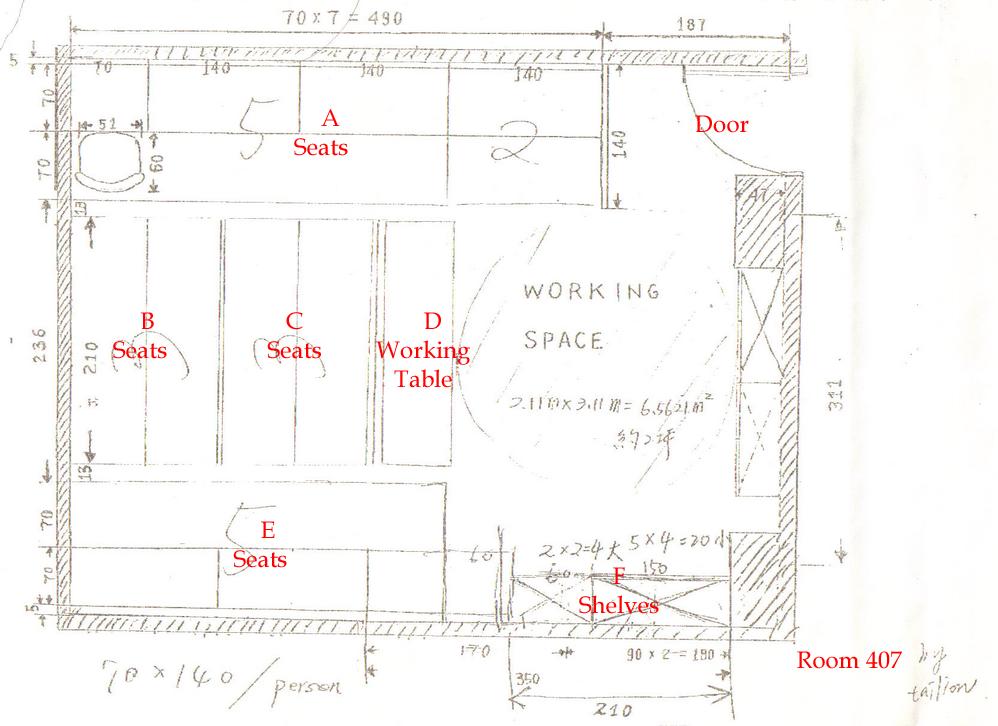
Blueprint of Room 407


Thanks Tailion for working on this.
This is about the blueprint of our lab space. Please let me know if you have any question/suggestion and comment on this post.

-any

Learning Through Smart Wheelchairs

The report

From 1990 to 1994 CALL ran two projects to first develop the Smart Wheelchair, and then evaluate them. The main outcome of the evaluation (apart from the Smart Wheelchairs themselves) was a report and annexes. Although this report was originally published in 1994, it is as relevant now as it was then. It is still one of the only pieces of qualitative research into the evaluation of the effective use of Smart Wheelchairs as a part of children’s emerging mobility, communication, education and personal development.

The report focuses on the development of the chair and the tools used to evaluate its use. Twelve CALL Centre Smart Wheelchairs were introduced to three Edinburgh based special schools.

Monday, August 22, 2005

Tutorial on Nonparametric Bayesian Methods

Zoubin Ghahramani
Bayesian methods provide a sound statistical framework for modelling and decision making. However, most simple parametric models are not realistic for modelling real-world data. Non-parametric models are much more flexible and therefore are much more likely to capture our beliefs about the data. They also often result in much better predictive performance. I will give a survey/tutorial of the field of non-parametric Bayesian statistics from the perspective of machine learning. Topics will include:
* The need for non-parametric models
* Gaussian processes and their application to classification, regression, and other prediction problems
* Chinese restaurant processes, different constructions, Pitman-Yor processes
* Dirichlet processes, Dirichlet process mixtures, Hierarchical Dirichlet processes and infinite HMMs
* Polya trees
* Dirichlet diffusion trees
* Time permitting, some new work on Indian buffet processes

The slides.

Saturday, August 20, 2005

MIT thesis defense: Feature-Based Pronunciation Modeling for Automatic Speech Recognition

Karen Livescu , Spoken Language Systems Group

Spoken language, especially conversational speech, is characterized by a great deal of variability in word pronunciation, including many variants that differ grossly from dictionary prototypes. This has been cited as a factor in the poor performance of automatic speech recognizers on conversational speech. One approach to handling this variation consists of expanding the dictionary with phonetic substitution, insertion, and deletion rules. This has the drawbacks that (1) many pronunciation variations typically remain unaccounted for, and (2) word confusability is increased due to the high granularity of phone units.

We present an alternative approach, in which many types of pronunciation variation are explained by representing speech as multiple streams of linguistic features rather than a single stream of phones. Features may correspond to the positions of the speech articulators, such as the lips and tongue, or to more abstract linguistic categories. By allowing for asynchrony between features and per-feature substitutions, many pronunciation changes that are difficult to account for with phone-based models become quite natural. Although it is well-known that many phenomena can be attributed to this ``semi-independent evolution'' of features, previous models of pronunciation variation have typically not taken advantage of this.

In particular, we propose a class of feature-based pronunciation models implemented using dynamic Bayesian networks (DBNs). The DBN approach allows us to naturally represent the factorization of the state space of feature combinations into factors corresponding to different features, as well as providing standard algorithms for inference and parameter learning. We investigate the behavior of such a model in isolation using manually transcribed speech data. These experiments suggest that when compared to a phone-based baseline, a feature-based model has both higher coverage of observed pronunciations and better recognition performance on isolated words excised from a conversational context. We also discuss the ways in which such a model can be incorporated into various types of end-to-end speech recognizers and present several examples of implemented systems, for both acoustic speech recognition and lipreading tasks.

advisee meeting

Below is the advisee meeting schedule. Please let me know if you have any problems. -Bob

August 25 (Thu)
1. 1:30 pm: Vincent
2. 2:00 pm: Nelson
3. 2:30 pm: Jim
4. 3:00 pm: Any
5. 3:30 pm: Chihao
6. 4:00 pm: Bright
7. 4:30 pm: Eric

CMU Thesis Oral: Control Synthesis for Dynamic Contact Manipulation

Siddhartha Srinivasa
Robotics Institute
Carnegie Mellon University

Manipulation is the art of moving things. At the heart of the problem, an object needs to be moved from start to goal by a robot that is in contact with the object. The contacts serve two purposes: they transmit forces and impose motion constraints on the object. Even if a robot can precisely control its own motion, it is constrained by the interactions at the contacts for control of the motion of the object. Contact interactions are governed by the laws of Coulomb friction and are nonlinear and non-Newtonian.

Current solutions to the manipulation problem decompose the problem into first solving for the forces required to produce a desired object motion and then commanding the robot to apply the requisite force. This imposed decomposition assumes that the robot is capable of producing the commanded forces and velocities required for manipulation. However, this assumption is broken in dynamic manipulation, where the robot operates close to actuator saturation.

In this thesis, we explore the planning and control of dynamic manipulation subject to actuator constraints. We describe a mapping of the Coulomb friction constraints and actuator constraints into a common space, obtaining a unified contact acceleration constraint. We propose two techniques for using this constraint to generate analytical trajectories for the dynamic manipulation problem. In the first technique of time-scaling, we decouple the problem into computing a feasible path followed by selecting the speed of motion along the path that satisfies the constraint. In the second technique of task and shape decomposition, we recognize that the constraint resides in a low dimensional subspace of the system state space and project the system dynamics onto, and orthogonal to that subspace. We use a feedback controller in the constraint space and plan for the orthogonal unconstrained freedoms. Finally, we demonstrate our techniques on two dynamic manipulation tasks and a constrained, nonholonomic system.

A copy of the thesis oral document can be found at http://www.cs.cmu.edu/~siddh/dissertation/thesis.pdf.

Thursday, August 18, 2005

Creating "Smart" Cars

Carnegie Mellon Builds New Technologies for the Family Car
Chriss Swaney

Will we still drive our cars, or will our cars drive us? We already have onboard navigation systems, infrared night vision, in-car satellite links, antiskid brakes and other electronic Samaritans ready to assist us when we need help behind the wheel.

Just around the corner, according to Carnegie Mellon researchers, are smart highways embedded with millions of tiny sensors and even smarter cars that are constantly aware of the traffic that is flowing around them. Drivers in the not-too-distant future will navigate from their home to the nearest freeway entrance ramp, at which time the car must take control of much of the driving task. Commuters will barrel down the highway at 120 mph with only a few inches between their car and the next. But will they be concerned?

More?

i-space summer retreat

FYI. -Bob


Hi i-spacers,

This is in preparation for the i-space summer retreat on 9/15 and 9/16. The
format is based on the spring retreat.

(1) At the start of the retreat, each faculty member can give an overview of their research activities (KJ and Bob can give a longer overview)
(2) Each faculty member gets no more than 100 minutes of students' presentation time, with each talk between 15~20 minutes (leaving 5 minutes for Q&A).
(3) We will have a demo session at the end of the retreat.

Please let me know if you or your students have any suggestions.

The retreat location will be on the NTU campus (either in CSIE or BL) to save money. We will provide lunch for all participants. Please feel free to send out invitations to your friends (industrial partners, collaborators, etc.).

I would like to propose the following two deadlines.

On 9/5
- estimate # of students from your lab who will attend
- estimate # of visitors
- submit the talks & demo titles & the name of speakers

On 9/12
- submit presentation slides

Please email the above information to 婕妤 (b90002@csie.ntu.edu.tw) and cc
me (hchu@csie.ntu.edu.tw).
Thanks,

Hao-hua Chu
Department of Computer Science and Information Engineering
Graduate Institute of Networking and Multimedia
National Taiwan University
hchu@csie.ntu.edu.tw

Tuesday, August 16, 2005

Free ultra-compact embedded PC's

Take a look at this web site. We may get a free embedded PC's.

機器人研發 我產業重點

2005.08.16  中國時報
機器人研發 我產業重點
李宗祐/台北報導

行政院科技顧問組昨日召開2005年產業科技策略(SRB)會議,決定將「智慧型機器人產業」列為我國新興科技產業發展重點,以商用服務、休閒娛樂、家庭服務以及老年照顧為重點產品,希望在2013年創造900億產值和2萬個工作機會。
科顧組指出,人類自1970年將產業用機器人引進市場後,過去10年伴隨著人工智慧和感測等技術陸續出現重大進展,也帶動服務用機器人世代的來臨,使科幻世界想像中的機器人世代,未來很可能快速在人類社會逐漸實現與應用。
經濟部工業局表示,服務用機器人目前正處於萌芽階段,根據各研究機構預估,2012年市場需求約在800億至 2500億美元之間,預測2003到2006年累計需求將達220萬台、3萬種應用產品出現。目前日本已將智慧型機器人列為新產業創造戰略7大領域之一,韓國也列為10大新世代成長動力產業之一,投入大量資金和人力積極發展。
工業局長陳昭義昨日在SRB會議指出,我國發展「智慧型機器人」產業規畫將以「賺錢」智慧型服務機械,快速切入全球市場為首要目標,例如強化電動代步車智慧型產品,其次是「掃地機」和「割草機」等智慧機械,再下來則是「保全機器人」等特殊用途機械人,以進入全球市場為推動目標。
政務委員兼科顧組副召集人林逢慶表示,由於我國精密機械、資訊電子、模具、光電、醫療照護及服務等產業,在世界舞台均具重要領導地位,擁有完整的技術、生產、供應體系與商品化等優勢能力,都是我國未來發展智慧型機器人產業的最大利基。

Monday, August 15, 2005

advisee meeting

Please make a resveration before this Wednesday.

August 18 (Thu)
1. 2:00 pm: Nelson
2. 2:30 pm: Jim
3. 3:00 pm: Any
4. 3:30 pm: Chihao
5. 4:00 pm: Bright
6: 4:30 pm

共同供應契約一覽表

Here is the link.

Sunday, August 14, 2005

國科會工程處「前瞻優質生活環境科技跨領域研究專案計畫」

the news

規劃研究項目:
一、超(人類)感知重點領域規劃計畫〔Super (Human) Senses〕
二、e化醫療保健重點領域規劃計畫 (E-Health)
三、智慧生活空間科技重點領域規劃計畫 (Smart Living Space)
四、能源與環境重點領域規劃計畫 (Energy & Environment)

Wednesday, August 10, 2005

Atom feeds for new-post notification

Blogger can be set to publish Atom feeds (machine readable form of the blogs), which can be read in RSS/Atom aggregators, which can notify the user of new posts (so that we don't have to check the website for new posts). More information from Blogger and Wikipedia.

Site feed for this blog is already enabled, at http://nturobots.blogspot.com/atom.xml.

There are lots of aggregator apps out there, and I have tried only one. For windows users, SharpReader seems good. For linux users, I recommend Akregator.

Tuesday, August 09, 2005

資訊系館天花板污損調查

To: 資訊系教授 / 實驗室助理及同學
(一)、請統計天花板『污損』及『破損』數量
系辦將瞭解漏水原因,改善後補足或換新。
(二)、 本次天花板之統計處所:
各『教授研究室』及『實驗室』。
P.S. 公共區域已另做統計
(三)、 請各位 教授及 實驗室助理(同學)於8月12日(星期五)前電話(或回函)系辦賴先生,俾便彙整辦理。
系辦公室 賴 先生 敬啟
Tel: 33664888 # 255
Fax: laich@csie.ntu.edu.tw

Please let me know if you can help me with this. Many thanks, -Bob

Cool Program: Google Earth

A 3D interface to the planet
Google Earth – Explore, Search and Discover

Could we build a 4D interface to the planet? -Bob

Monday, August 08, 2005

meeting

This is about the advisee meeting again. If you want to talk to me this Thursday, please make a resveration before this Wednesday. Thanks, -Bob

August 11 (Thu)
1. 2:00 pm Shao-Wen
2. 2:30 pm
3. 3:00 pm
4. 3:30 pm
5. 4:00 pm
6: 4:30 pm

Thesis Oral: Models for Learning Spatial Interactions in Natural Images for Context-Based Classification

Sanjiv Kumar
Robotics Institute
Carnegie Mellon University

Classification of various image components (pixels, regions and objects) in meaningful categories is a challenging task due to ambiguities inherent to visual data. Natural images exhibit strong contextual dependencies in the form of spatial interactions among components. For example, neighboring pixels tend to have similar class labels, and different parts of an object are related through geometric constraints. Going beyond these, different regions e.g., sky and water, or objects e.g., monitor and keyboard appear in restricted spatial configurations. Modeling these interactions is crucial to achieve good classification accuracy.

In this thesis, we present discriminative field models that capture spatial interactions in images in a discriminative framework based on the concept of Conditional Random Fields proposed by Lafferty et al. The discriminative fields offer several advantages over the Markov Random Fields (MRFs) popularly used in computer vision. First, they allow to capture arbitrary dependencies in the observed data by relaxing the restrictive assumption of conditional independence generally made in MRFs for tractability. Second, the interaction in labels in discriminative fields is based on the observed data, instead of being fixed a priori as in MRFs. This is critical to incorporate different types of context in images within a single framework. Finally, the discriminative fields derive their classification power by exploiting probabilistic discriminative models instead of the generative models used in MRFs.

Since the graphs induced by the discriminative fields may have arbitrary topology, exact maximum likelihood parameter learning may not be feasible. We present an approach which approximates the gradients of the likelihood with simple piecewise constant functions constructed using inference techniques. To exploit different levels of contextual information in images, a two-layer hierarchical formulation is also described. It encodes both short-range interactions (e.g., pixelwise label smoothing) as well as long-range interactions (e.g., relative configurations of objects or regions) in a tractable manner. The models proposed in this thesis are general enough to be applied to several challenging computer vision tasks such as contextual object detection, semantic scene segmentation, texture recognition, and image denoising seamlessly within a single framework.

A copy of the thesis oral document can be found at http://www.cs.cmu.edu/~skumar/thesis.pdf.

Saturday, August 06, 2005

Invitations for The Welcome Party

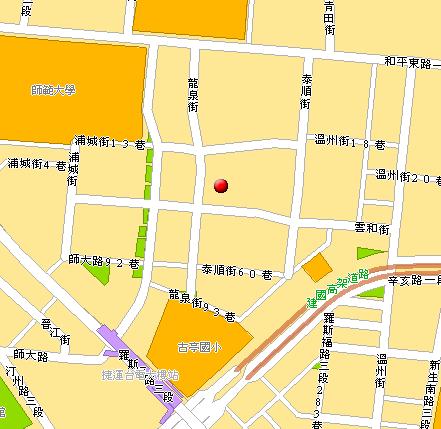
You are invited to 米倉咖啡酒館 for dinner and an evening of entertainment on Sunday, August 14th beginning at 6pm. The menu will consist of 義大利麵, 三明治, 墨西哥捲餅, 甜點, 啤酒, 調酒, etc. I thought that after we ate, we could play some card games, say poker, and have further discuss about our lab space, research topics and whatever you want to say.

Place: 米倉咖啡酒館, 台北市泰順街44巷25號1樓
Time: 6pm, Sun, Aug 14


It is guaranteed to be fun of course. Please let me know as soon as possible whether or not you can attend this party and comment on this post since we have to make a reservation for the balcony seats in advance. My phone number is 0935-219529. Feel free to call if you have any questions.

-any

CNN: Scanning tech reveals mummy mysteries

Friday, August 5, 2005; Posted: 10:29 a.m. EDT (14:29 GMT)
SAN FRANCISCO, California (AP) -- Researchers have uncovered the mysteries surrounding a 2,000-year-old mummy without peeling back layers of bandages or even opening the gold-plated coffin.

Using a state-of-the-art CT scanner that rotated all the way around the tiny mummified girl, San Jose-based Silicon Graphics Inc. took 60,000 images and created 3-D models that allowed scientists to look at her resin-filled body cavities, her facial features, even her baby teeth. (More...)

Friday, August 05, 2005

Thesis Defense: Learning Static Object Segmentation from Motion Segmentation

Michael G. Ross , MIT CSAIL
Date: Wednesday, August 10 2005

Dividing an image into its constituent objects can be a useful first step in many visual processing tasks, such as object classification or determining the arrangement of obstacles in an environment. Motion segmentation is a rich source of training data for learning to segment objects by their static image properties. Background subtraction can distinguish between moving objects and their surroundings, and the techniques of statistical machine learning can capture information about objects' shape, size, color, brightness, and texture properties. Presented with a new, static image, the trained model can infer the proper segmentation of the objects present in a scene. The algorithm presented in this work uses the techniques of Markov random field modeling and belief propagation inference, outperforms a standard segmentation algorithm on an object segmentation task, and outperforms a learned boundary detector at determining object boundaries on the test data.

Thursday, August 04, 2005

Call For Paper (CFP)

*Call for Papers:Joint Issue of IJCV and IJRR on Vision and Robotics*

Over the past several years, there has been rapid progress in the development of vision techniques applicable to robotics. At the same time vision has become a more practical and affordable technology for robotics applications. However, the scientific interests of both communities have diverged to the point that few major journals or conferences publish new and innovative results at the confluence of vision and robotics.

The goal of this joint issue of IJCV and IJRR is to provide a forum for the communication of new ideas at the interface between the vision and robotics communities. Topics of interest include (but are not limited to):
- Vision and control
- Vision and manipulation
- Vision and mobility
- Vision and navigation
- Vision combined with other sensors such as range, force or tactile
- Unique visual sensors suited to robotic applications
- Robotic systems incorporating vision sensors in novel ways
- Applications of vision and robotics

The joint issue will appear simultaneously in both journals, and will include an editors' forward that outlines the content of both journals. The preliminary deadline for paper submission is *October 1, 2005*. Instructions and updated information on submission can be found at: http://www.vision-based-control.org/JointIssue

Guest Editors:
Gregory D. Hager, Johns Hopkins University
Seth Hutchinson, University of Illinois Urbana-Champaign
Martial Hebert, Carnegie Mellon

Lab Space

The department agreed to fix the holes on the floor and repaint the lab. Please let me know if you find any other problems. -Bob

Wednesday, August 03, 2005

Thesis Oral: Game Theoretic Control for Robot Teams

Rosemary Emery-Montemerlo
Robotics Institute, Carnegie Mellon University

Abstract
Planning for a decentralized team of robots is a fundamentally different problem from that of centralized control. During decision making, robots must take into account not only their own observations of world state, but also the possible observations and actions of teammates. While the interconnectedness of such a reasoning process seems to require an infinite recursion of beliefs to be modelled by each member of the team, game theory provides an alternative approach. Partially observable stochastic games (POSGs) generalize notions of single-stage games and Markov decision processes to both multiple agents and partially observable worlds. Even if there is only limited communication between teammates, POSGs allow robots to come up with policies that still take into account possible teammate experiences without the need to explicitly model any recursive beliefs about those experiences.

While a powerful model of decentralized teams, POSGs are computationally intractable for all but the smallest problems. This dissertation proposes a Bayesian game approximation to POSGs in which game theoretic reasoning about action selection is retained, but robots reason only a limited time ahead about uncertainty in world state and the experiences of their teammates. Planning and execution are interleaved to further reduce computational burdens: at each time step robots perform a step of full game theoretic reasoning about their current action selection given any possible history of observations and a heuristic evaluation of the expected future value of those decisions.

The Bayesian game approximation algorithm (BaGA) is able to find solutions to much larger problems than previously solved. Further computational savings are gained by reasoning about groups of similar observation histories rather than single histories. Finally, efficiency and performance are also improved through the use of run-time communication policies that trade-off expected gains in performance with the costs of using bandwidth. In this dissertation, the performance of BaGA is compared to policies generated for full POSGs as well as heuristics. BaGA is also used to develop real-time robot controllers for a series of simulated and physical robotic tag problems that gradually increase in realism.

A copy of the thesis oral document can be found at http://www.cs.cmu.edu/~remery/thesis/remery-thesis.pdf.

Tuesday, August 02, 2005

Our Lab Space (Room 407)

This image is about our lab space. We can choose what kind of furniture we need. Does anyone have good ideas? We can discuss all the details on welcome party next week.

About Welcome Party

For some reason, the welcome party will be moved to next week, say from 6pm onwards. Please leave your available dates below.

Your attendance will be greatly appreciated!

Individual meeting

Hi Folks,

Before the semester begins, I can hold individual meetings every Thursdays. If you want to talk to me, you can pick a slot and comment on this post.

-Bob

August 4 (Thu)
1. 2:00 pm
2. 2:30 pm
3. 3:00 pm
4. 3:30 pm
5. 4:00 pm
6: 4:30 pm

Monday, August 01, 2005

Taking a Look at Our Lab Space

Since we have to discuss something about our lab space at the welcome party, such as how to arrange it, when to clean it, etc., Bob and I plan to arrange a meeting at NTU in the coming 2 days such that we can talk with Bob and take a look at our lab space.

Please let me know if you can attend this meeting or just leave your available time slot below if you can!

My mobile-phone number: 0935-219529

Thursday, July 28, 2005

the RoboCup 2005 Symposium

The proceedings are available here. The files could be removed soon.

-Bob

Tuesday, July 26, 2005

PhD Oral: path planning

Extending the Path-planning Horizon

Bart Nabbe
Robotics Institute
Carnegie Mellon University

Abstract: The mobility sensors (LADAR, stereo, etc.) on a typical mobile robot vehicle can only acquire data up to a distance of a few tens of meters. Therefore a navigation system has no knowledge about the world beyond this sensing horizon. As a result, path planners that rely only on this knowledge to compute paths are unable to anticipate obstacles sufficiently early and have no choice but to resort to an inefficient behavior of local obstacle contour tracing. To alleviate this problem, we present an opportunistic navigation and view planning strategy that incorporates look-ahead sensing of possible obstacle configurations. This planning strategy is based on a what-if analysis of hypothetical future configurations of the environment. Candidate vantage positions are evaluated based on their ability of observing anticipated obstacles. These vantage positions identified by this forward-simulation framework are used by the planner as intermediate waypoints. The validity of the strategy is supported by results from simulations as well as field experiments with a real robotic platform. These results also show that opportunistically significant reduction in path length can be achieved by using this framework.

Talk at CMU: Spatiotemporal Modeling of Facial Expressions

Maja Pantic
Delft University of Technology

Abstract:

Machine understanding of facial expressions could revolutionize human-machine interaction technologies and fields as diverse as security, behavioral science, medicine, and education. Consequently, computer-based recognition of facial expressions has become an active research area.

Most systems for automatic analysis of facial expressions attempt to recognize a small set of "universal" emotions such as happiness and anger. Recent psychological studies claim, however, that facial expression interpretation in terms of emotions is culture dependent and may even be person dependent. To allow for rich and sometimes subtle shadings of emotion that humans recognize in a facial expression, context-dependent (e.g., user- and task-dependent) recognition of emotions from images of faces is needed.

We propose a case-based reasoning system capable of classifying facial expressions (given in terms of facial muscle actions) into the emotion categories learned from the user. The utilized case base is a dynamic, incrementally self-organizing event-content-addressable memory that allows fact retrieval and evaluation of encountered events based upon the user preferences and the generalizations formed from prior input.

Three systems for automatic recognition of facial muscle actions (i.e., Action Units, AUs) in face video will be presented as well. One of these uses temporal templates as the data representation and a combined k-Nearest-Neighbor and rule-based classifier as the recognition engine. Temporal templates are 2D representations of motion history, that is, they picture where and when motion in the input image sequence has occurred. The other two systems exploit particle filtering to track facial characteristic points in an input face video. One of those systems performs facial-behavior temporal-dynamics recognition in face-profile image sequences using temporal rules. The other employs Support Vector Machines to encode 20 AUs occurring alone or in combination in an input nearly-frontal view face video.

The systems have been trained and tested using two different databases: the Cohn-Kanade facial expression database and our own web-based MMI facial expression database. The recognition results achieved by the proposed systems demonstrated rather high concurrent validity with human coding.

Bio: Maja (Maya) Pantic received the MS and PhD degrees in computer science from Delft University of Technology, in 1997 and 2001. She is currently an associate professor at the Faculty of Electrical Engineering, Mathematics and Computer Science, Delft University of Technology, The Netherlands, where she is doing research in the area of machine analysis of human interactive cues for achieving a natural, multimodal human-machine interaction. She is the (co-) principal investigator in three large, national, ongoing projects in the area of multimodal, affective, human-machine interaction. She was the organizer and co-organizer of various meetings and symposia on Automatic Facial Expression Analysis and Synthesis and she is the Associate Editor of the IEEE Transactions on Systems, Man, and Cybernetics - Part B: Cybernetics, responsible for computer vision and its applications to human-computer interaction. In 2002, for her research on Facial Information For Advanced Interface, she received Innovational Research Award of Dutch Scientific Organization as one of the 7 best young scientists in exact sciences in the Netherlands. She is currently a visiting professor at the Robotics Institute, Carnegie Mellon University. She has published more than 40 technical papers in the areas of machine analysis of facial expressions and emotions, artificial intelligence, and human-computer interaction and has served on the program committee of several conferences in these areas. For more information, please see http://mmi.tudelft.nl/~maja/

Monday, July 25, 2005

Tutorials on Graphical Models

David Heckerman
Tutorial and applications overview for data miner – slides from KDD 2004

Phd Thesis: Microscopic Pedestrain Flow Characteristics

Kardi Teknomo,
Microscopic Pedestrian Flow Characteristics: Development of an Image Processing Data Collection and Simulation Model,
Ph.D. Dissertation, Tohoku University Japan, Sendai, 2002.

Friday, July 22, 2005

EE/CS Course List

ftp://anonymous@ftp.ntu.edu.tw/NTU/course/COURSE09.XLS

Paper: SIFT feature

David G. Lowe
Distinctive image features from scale-invariant keypoints
International Journal of Computer Vision, 60, 2 (2004), pp. 91-110.
Demo Software

Paper: Inference and Learning

Brendan J. Frey and Nebojsa Jojic
Advances in Algorithms for Inference and Learning in Complex Probability Models
2003?
Abstract: Computer vision is currently one of the most exciting areas of artificial intelligence research, largely because it has recently become possible to record, store and process large amounts of visual data. Impressive results have been obtained by applying discriminative techniques in an ad hoc fashion to large amounts of data, e.g., using support vector machines for detecting face patterns in images. However, it is even more exciting that researchers may be on the verge of introducing computer vision systems that perform realistic scene analysis, decomposing a video into its constituent objects, lighting conditions, motion patterns, and so on. In our view, two of the main challenges in computer vision are finding efficient models of the physics of visual scenes and finding efficient algorithms for inference and learning in these models. In this paper, we advocate the use of graph-based generative probability models and their associated inference and learning algorithms for computer vision and scene analysis. We review exact techniques and various approximate, computationally efficient techniques, including iterative conditional modes, the expectation maximization algorithm, the mean field method, variational techniques, structured variational techniques, Gibbs sampling, the sum-product algorithm and “loopy” belief propagation. We describe how each technique can be applied to an illustrative example of inference and learning in models of multiple, occluding objects, and compare the performances of the techniques.

Talk: Learning to See People

Michael J. Black
Learning to See People, Invited talk, Twenty-First International Conference on Machine Learning (ICML 2004), Banff, Alberta, Canada, July 4-8, 2004.

Talk: Michael J. Tarr

I have the sildes of Michael J. Tarr about "Human Object Recognition: Do we know more than we did 20 years ago?". It is interesting, but I can not find the link at the moment. -Bob

Book list

This list is only for myself. :)
-Bob

J. Whittaker. Graphical Models in Applied Mathematical Multivariate Statistics. John Wiley & Sons, 1990.
Steffen L. Lauritzen. Graphical Models. Clarendon Press, London, 1996.
L. W. Beineke and R. J. Wilson. Graph Connection: Relationships Between Graph Theory and Other Areas of Mathematics. Clarendon Press, London, 1997.
G. Hinton and T. J. Sejnowski. Unsupervised Learning: Foundations of Neural Computation. The MIT Press, 1999.
M. I. Jordan and T. J. Sejnowski. Graphical Models: Foundations of Neural Computation. The MIT Press, 2001.
S. N. Lahiri. Resampling Methods for Dependent Data. Springer 2003.

Paper: Plan Recognition

Hung H. Bui
Efficient Approximate Inference for Online Probabilistic Plan Recognition
Nov. 2002
A General Model for Online Probabilistic Plan Recognition, IJCAI 2003

Georgia Institute of Technology
Expectation Grammars: Leveraging High-Level Expectations for Activity Recognition, CVPR 2003
Asymmetrically Boosted HMM for Speech Reading, CVPR2004
Propagation Networks for Recognition of Partially Ordered Sequential Action, CVPR2004

Jianbo Shi
Detecting Unusual Activity in Video, CVPR2004

Conditional Random Fields

Notes on Conditional Random Fields from Hanna M. Wallach.

Paper: Markov Random Fields

Hinton, G. E., Osindero, S. and Bao, K.
Learning Causally Linked Markov Random Fields.
In: Artificial Intelligence and Statistics, 2005, Barbados

Abstract:We describe a learning procedure for a generative model that contains a hidden Markov Random Field (MRF) which has directed connections to the observable variables. The learning procedure uses a variational approximation for the posterior distribution over the hidden variables. Despite the intractable partition function of the MRF, the weights on the directed connections and the variational approximation itself can be learned by maximizing a lower bound on the log probability of the observed data. The parameters of the MRF are learned by using the mean field version of contrastive divergence [1]. We show that this hybrid model simultaneously learns parts of objects and their inter-relationships from intensity images. We discuss the extension to multiple MRF's linked into in a chain graph by directed connections.

Paper: Unsupervised Mining

Lexing Xie, Shih-Fu Chang, Ajay Divakaran, Huifang Sun.
Unsupervised Mining of Statistical Temporal Structures in Video.
In Video Mining, A. Rosenfeld, D. Doremann, D. Dementhon (eds.), Chap. 10, Kluwer Academic Publishers, 2003
The DVMM Lab at Columbia University

Thursday, July 21, 2005

Papers: Activities and Interactions

NIPS2004: Workshop on Activity Recognition and Discovery

Nuria Oliver, Barbara Rosario and Alex Pentland.
A Bayesian Computer Vision System for Modeling Human Interactions
IEEE Transactions on Pattern Analysis and Machine Intelligence, August 2000.

Yuri A. Ivanov and Aaron F. Bobick
Recognition of Visual Activities and Interactions by Stochastic Parsing
IEEE Transactions on Pattern Analysis and Machine Intelligence, August 2000.

Stephen S. Intille and Aaron F. Bobick
Recognizing Planned, Multiperson Action
Computer Vision and Image Understanding 81, 414-445, 2001
A Framework for Recognizing Multi-Agent Action from Visual Evidence
AAAI 1999

Notes: Information Geometry

Notes on Information Geometry from Cosma Rohilla Shalizi.

Paper: Social Interactions

Charles F. Manski

Economic Analysis of Social Interactions
March 2000, forthcoming in the Journal of Economic Perspectives

Abstract: Economists have long been ambivalent about whether the discipline should focus on the analysis of markets or should be concerned with social interactions more generally. Recently the discipline has sought to broaden its scope while maintaining the rigor of modern economic analysis. Major theoretical developments in game theory, the economics of the family, and endogenous growth theory have taken place. Economists have also performed new empirical research on social interactions, but the empirical literature does not show progress comparable to that achieved in economic theory. This paper examines why and discusses how economists might make sustained contributions to the empirical analysis of social interactions.

Nobel Lecture: The Economic Way of Looking at Behavior

Gary S. Becker
Winner of the 1992 Nobel Prize in Economics

Abstract: An important step in extending the traditional theory of individual rational choice to analyze social issues beyond those usually considered by economists is to incorporate into the theory a much richer class of attitudes, preferences, and calculations. While this approach to behavior builds on an expanded.theory of individual choice, it is not mainly concerned with individuals. It uses theory at the micro level as a powerful tool to derive implications at the group or macro level. The lecture describes the approach and illustrates it with examples drawn from the author's past and current work.

Download link

Paper: Unsupervised Learning

Kilian Weinberger & Lawrence Saul

Unsupervised Learning of Image Manifolds by Semidefinite Programming
CVPR 2004

Abstract: Can we detect low dimensional structure in high dimensional data sets of images and video? The problem of dimensionality reduction arises often in computer vision and pattern recognition. In this paper, we propose a new solution to this problem based on semidefinite programming. Our algorithm can be used to analyze high dimensional data that lies on or near a low dimensional manifold. It overcomes certain limitations of previous work in manifold learning, such as Isomap and locally linear embedding. It also bridges two recent developments in machine learning: semidefinite programming for learning kernel matrices and spectral methods for nonlinear dimensionality reduction. We illustrate the algorithm on easily visualized examples of curves and surfaces, as well as on actual images of faces, handwritten digits, and solid objects.

Tuesday, July 19, 2005

Paper: Dynamic Maps

Peter Biber, Tom Duckett

Dynamic Maps for Long-Term Operation of Mobile Service Robots


Robotics: Science and Systems, June, 2005

Abstract: This paper introduces a dynamic map for mobile robots that adapts continuously over time. It resolves the stabilityplasticity dilemma (the trade-off between adaptation to new patterns and preservation of old patterns) by representing the environment over multiple timescales simultaneously (5 in our experiments). A sample-based representation is proposed, where older memories fade at different rates depending on the timescale. Robust statistics are used to interpret the samples. It is shown that this approach can track both stationary and non-stationary elements of the environment, covering the full spectrum of variations from moving objects to structural changes. The method was evaluated in a five week experiment in a real dynamic environment. Experimental results show that the resulting map is stable, improves its quality over time and adapts to changes.

Saturday, July 16, 2005

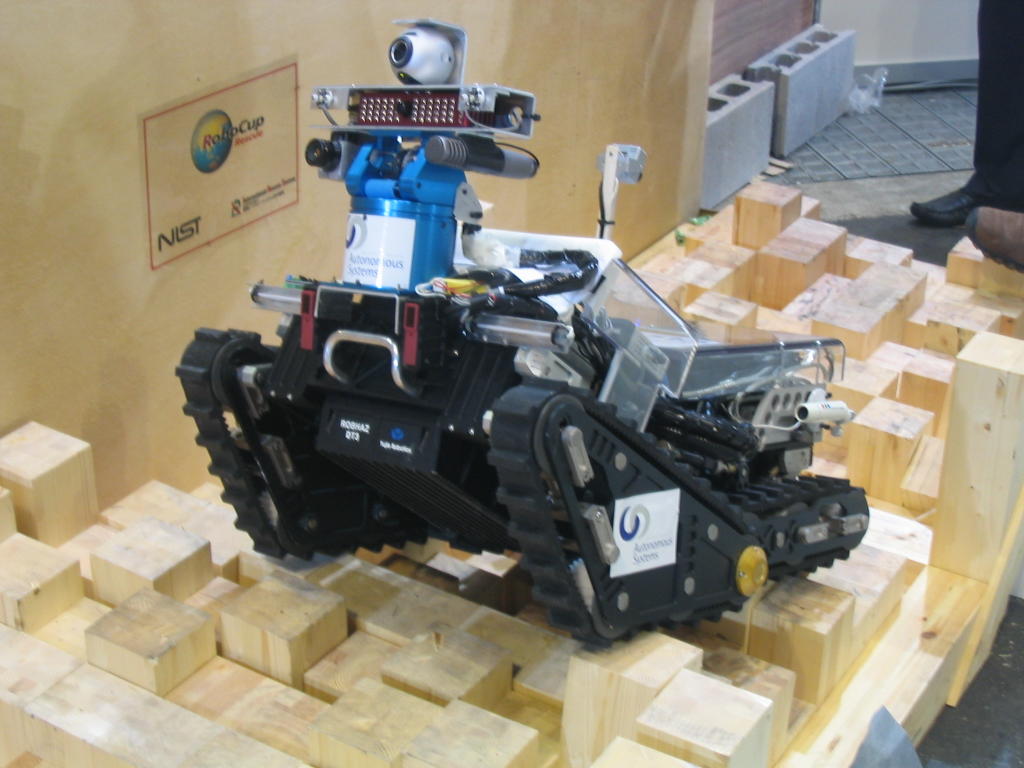
Robocup 2005


Robocup Rescue League: ARC CAS team
Photo by Jonathan Paxman

Friday, July 15, 2005

News: Intel experiments with Wi-Fi as GPS substitute

By Michael Kanellos, CNET News.com
Published on ZDNet News: July 12, 2005, 4:30 PM PT

SAN JOSE, Calif.--The satellites that comprise the global positioning system can pinpoint a person's location to within a few meters. Intel is experimenting with ordinary wireless networks to see if the same job can be done on land.

Link.

You should be able to find some related papers in previous posts. -Bob

News: I, Roommate: The Robot Housekeeper Arrives

The New York Times:

By MARK ALLEN
Published: July 14, 2005

WHEN my home robot arrived last month, its smiling inventors removed it from its box and laid it on its back on my living room floor. They leaned over and spoke to it, as one might to a sleeping child.

It straightened, let out a little beep, lighted up, looked left and right, and then, amazingly, stood and faced me.

I said, "Nuvo, how are you?"

It tilted to the left, and raised one arm to greet me. It shook my hand and winked with one of the lights in its little head. My life hasn't really been the same since.

More? Click Here

Thursday, July 14, 2005

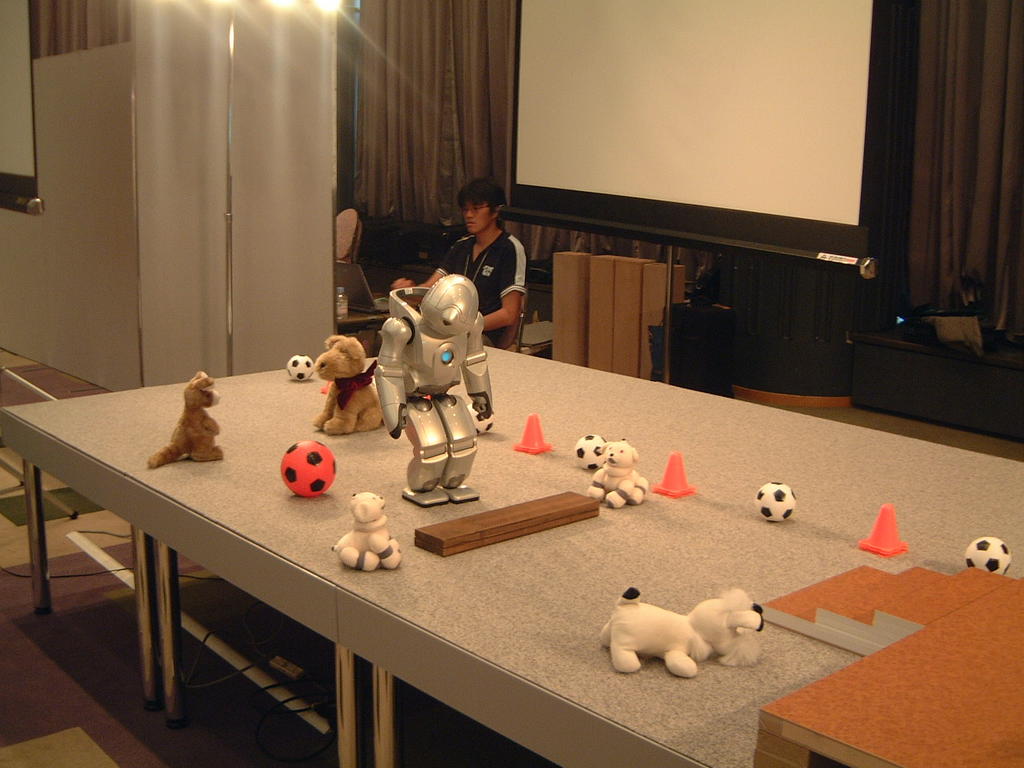
Sony QRIO


Demo preparation
IROS2004, Sendai, Japan

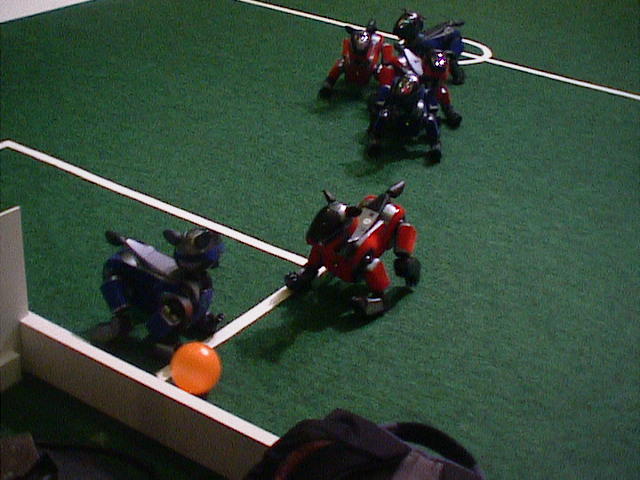
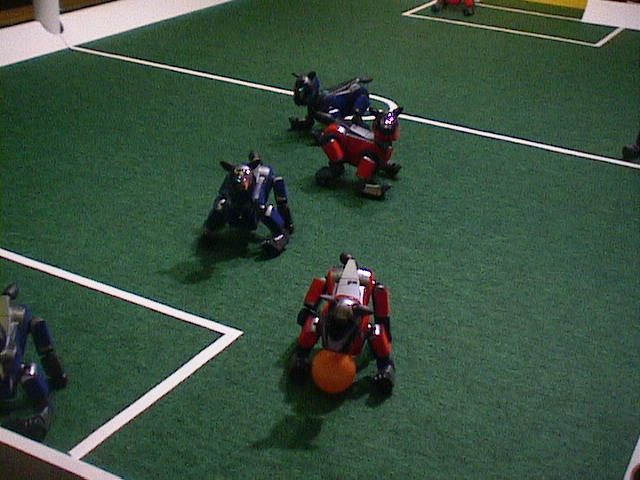
American Open 2003 @ CMU

frame 2: defence

frame 1: attack

Summer 2002 at NASA Ames

NASA K-9 platform

PhD Thesis: Activity Map

Learning an Activity-Based Semantic Scene Model

Dimitrios Makris (2004)
City University, London
School of Engineering and Mathematical Sciences
Information Engineering Centre

Abstract
This thesis investigates how scene activity, which is observed by fixed surveillance cameras, can be modelled and learnt. Modelling of activity is performed through a spatio-probabilistic scene model that contains semantics like entry/exit zones, paths, junctions, routes and stop zones. The spatial nature of the model allows physical and semantic representation of the scene features, which can be useful in applications like video annotation and contextual databases. The probabilistic nature of the model encodes the variance and the related uncertainty of the usage of the scene features, which is useful for activity analysis applications, such as motion prediction and atypical motion detection.
A variety of models and learning methods are used to represent and automatically derive particular activity-based semantic scene elements. Expectation-Maximisation is used for learning Gaussian Mixture Models and accumulative statistics in image maps are integrated in the methods presented. Also, a novel route model and an appropriate learning algorithm are introduced. Additionally, a Hidden Markov Model superimposed on the scene model is used for enabling activity analysis.
The application of the methods is investigated for single cameras and collectively across multiple cameras. Additionally, a novel automatic cross-correlation method is introduced that reveals the topology of a network of activities, as observed by a network of uncalibrated cameras. The method is important not only because it provides an integrated activity model for all the cameras, but also because it provides a mechanism to automatically estimate the topology of the camera network, modelling the activity across the “blind” areas of the surveillance system.
All the proposed learning algorithms are unsupervised to allow automatic learning of the scene model. Their input is a set of noisy trajectories derived automatically by motion tracking modules, attached to each of the cameras.

International Hands-on Competition 2005

For your information, -Bob

Dear Colleagues:

On behalf of President Ren C. Luo at National Chung Cheng University (NCCU), Taiwan, we are pleased to invite you and your students to participate “2005 International Student Experimental Hands-on Project Competition via Internet on Intelligent Mechatronics and Automation”. The objective of this competition is to stimulate the advancement of mechatronics among students’ experimental research projects. The feature of this competition activity is to use Internet visual communication techniques to reduce the logistic problems. Please see the attachment or visit our web site at: http://www.handson.org.tw for detailed information.

Hereby, we are sending you the Call for Participations. The deadline to submit the video for preliminary review is September 15, 2005. The final live competition via Internet is scheduled for December 9, 2005.

We look forward to having your participation.

Sincerely,

******************************
Chao-Chu Chen (Ms.)
Hands-on 2005 Secretariat
National Chung Cheng University
Automation Research Center
168, University Rd., Min-Hsiung
Chia-Yi, Taiwan, 621, R.O.C.
TEL: 886-5-272-0411 ext.16755
FAX: 886-5-272-3941
Email: handson@ia.ee.ccu.edu.tw
******************************

Wednesday, July 13, 2005

Papers: planning in dynamic environments

Jur P. van den Berg, D. Nieuwenhuisen, L. Jaillet and M. Overmars
Creating Robust Roadmaps for Motion Planning in Changing Environments
IROS 2005

Abstract
In this paper we introduce a method based on the Probabilistic Roadmap (PRM) Planner to construct robust roadmaps for motion planning in changing environments. PRM’s are usually aimed at static environments. In reality though, many environments are not static, but contain moving obstacles as well. Often the motion of these obstacles is not unconstrained, but is restricted to some confined area, e.g. a door that can be open or closed or a chair which is bounded to a room. We exploit this observation by assuming that a moving obstacle has a predefined set of potential placements. We present a variant of PRM that is robust against placement changes of obstacles. Our method creates a roadmap that is guaranteed to contain a path for any feasible query when time goes to infinity, i.e. the method is probabilistically complete. Our implementation shows that after a roadmap is created in the preprocessing phase, queries can be solved instantaneously, thus allowing for on-the-fly replanning to anticipate changes in the environment.


Gazihan Alankus, Nuzhet Atay, Chenyang Lu, O. Burchan Bayazit
SPATIOTEMPORAL QUERY STRATEGIES FOR NAVIGATION IN DYNAMIC SENSOR NETWORK ENVIRONMENTS
IROS 2005

Abstract
Autonomous mobile agent navigation is crucial to many mission-critical applications (e.g., search and rescue missions in a disaster area). In this paper, we present how sensor networks may assist probabilistic roadmap methods (PRMs), a class of efficient navigation algorithms particularly suitable for dynamic environments. A key challenge of applying PRM algorithms in dynamic environment is that they require the spatiotemporal sensing of the environment to solve a given navigation problem. To facilitate navigation, we propose a set of query strategies that allow a mobile agent
to periodically collect real-time information (e.g., fire conditions) about the environment through a sensor network. Such strategies include local spatiotemporal query (query of spatial neighborhood), global spatiotemporal query (query of all sensors), and border query (query of the border of danger fields). We investigate the impact of different query strategies through simulations under a set of realistic fire conditions. We also evaluate the feasibility of our approach using a real robot and real motes. Our results demonstrate that (1) spatiotemporal queries from a sensor network result in significantly better navigation performance than traditional approaches based on on-board sensors of a robot, (2) the area of local queries represent a tradeoff between communication cost and navigation performance, (3) through in-network processing our border query strategy achieves the best navigation performance at a small fraction of communication cost compared to global spatiotemporal queries.

Monday, July 11, 2005

AAAI-05 Outstanding Paper Award.

Vincent A. Cicirello, my office mate between 1999-2000 at CMU, and his adviser, Stephen F. Smith, won the twentieth National Conference on Artificial Intelligence (AAAI-05) Outstanding Paper Award for the paper entitled "The Max K-Armed Bandit: A New Model of Exploration Applied to Search Heuristic Selection".

Congratulations!

Paper: Robotic Mapping

Mark A. Paskin and Sebastian Thrun
Robotic Mapping with Polygonal Random Fields
UAI 2005

Abstract
Two types of probabilistic maps are popular in the mobile robotics literature: occupancy grids and geometric maps. Occupancy grids have the advantages of simplicity and speed, but they represent only a restricted class of maps and they make incorrect independence assumptions. On the other hand, current geometric approaches, which characterize the environment by features such as line segments, can represent complex environments compactly. However, they do not reason explicitly about occupancy, a necessity for motion planning; and, they lack a complete probability model over environmental structures. In this paper we present a probabilistic mapping technique based on polygonal random fields (PRF), which combines the advantages of both approaches. Our approach explicitly represents occupancy using a geometric representation, and it is based upon a consistent probability distribution over environments which avoids the incorrect independence assumptions made by occupancy grids. We show how sampling techniques for PRFs can be applied to localized laser and sonar data, and we demonstrate significant improvements in mapping performance over occupancy grids.

Paper: Smartphones

E. Horvitz, J. Apacible, R. Sarin, and L. Liao (2005).
Prediction, Expectation, and Surprise: Methods, Designs, and Study of a Deployed Traffic Forecasting Service
Twenty-First Conference on Uncertainty in Artificial Intelligence, UAI-2005, Edinburgh, Scotland, July 2005.

Abstract
We present research on developing models that forecast traffic flow and congestion in the Greater Seattle area. The research has led to the deployment of a service named JamBayes, that is being actively used by over 2,500 users via smartphones and desktop versions of the system. We review the modeling effort and describe experiments probing the predictive accuracy of the models. Finally, we present research on building models that can identify current and future surprises, via efforts on modeling and forecasting unexpected situations.

talk at CMU: Tracking Across Multiple Moving Cameras

Dr. Mubarak Shah
Computer Vision Lab, School of Computer Science
University of Central Florida, Orlando, FL 32816
http://www.cs.ucf.edu/~vision/

Check out their ICCV2005 papers!

The concept of a cooperative multi-camera system, informally a 'forest' of sensors, has recently received increasing attention from the research community. The idea is of great practical relevance, since cameras typically have limited fields of view, but are now available at low costs. Thus, instead of having a high-resolution camera that surveys a large area, far greater flexibility and scalability can be achieved by observing a scene 'through many eyes', using a multitude of lower-resolution COTS (commercial off-the-shelf) cameras.

In this talk I will present two approaches for object tracking across multiple moving cameras. In the first approach, objects are to be tracked across several cameras, each mounted on an aerial vehicle, without any telemetry or calibration information. The principal assumption that is made in this work is that the altitude of the camera allows the scene to be modeled well by a plane. First the global motion is compensated in each video sequence and objects are detected and tracked in individual cameras. For solving multiple camera correspondence problem we exploit constraints on the relationship between the motion of each object across cameras, estimating the probability that trajectories in two views originated from the same object, to test multiple correspondence hypotheses (without assuming any calibration information).

In the second approach we consider sequences acquired by hand-held cameras, for which planar scene assumption is not valid. Recently we have proposed a notion of temporal fundamental matrix to capture the epi-polar geometry between the temporal views of independently moving camera pair where the scene is dynamic. The temporal fundamental matrix, which is a 3x3 matrix capturing the temporal variation of the geometry. Constraining the rotational and translational motion of cameras to polynomials in time, we have shown that the components of the fundamental matrix are polynomials in time. In order to obtain the correct correspondences across the multiple moving cameras, we perform a maximum bipartite matching of a graph, in which the weights of the edges depend on the properties of the temporal fundamental matrix.

======================================
Dr. Mubarak Shah, Agere Chair professor of Computer Science, and the founding director of the Computer Vision Laboratory at University of Central Florida (UCF), is a researcher in computer vision. He is a co-author of two books Video Registration (2003) and Motion-Based Recognition (1997), both by Kluwer Academic Publishers. He has worked in several areas including activity and gesture recognition, violence detection, event ontology, object tracking (fixed camera, moving camera, multiple overlapping and non-overlapping cameras), video segmentation, story and scene segmentation, view morphing, ATR, wide-baseline matching, and video registration. . Dr. Shah is a fellow of IEEE, was an IEEE Distinguished Visitor speaker for 1997-2000, and is often invited to present seminars, tutorials and invited talks all over the world. He received the Harris Corporation Engineering Achievement Award in 1999, the TOKTEN awards from UNDP in 1995, 1997, and 2000; Teaching Incentive Program award in 1995 and 2003, Research Incentive Award in 2003, and IEEE Outstanding Engineering Educator Award in 1997. He is an editor of international book series on "Video Computing"; editor in chief of Machine Vision and Applications journal, and an associate editor Pattern Recognition journal. He was an associate editor of the IEEE Transactions on PAMI, and a guest editor of the special issue of International Journal of Computer Vision on Video Computing.

Tuesday, July 05, 2005

Jobs: Computer Vision, Pattern Recognition

1. INDUSTRIAL LIGHT + MAGIC
RESEARCH AND DEVELOPMENT IS SEEKING COMPUTER VISION SPECIALISTS

SUMMARY
ILM is currently seeking computer vision specialists for our Research and Development department. Key technologies include 2d and 3d tracking, matchmove, 3d reconstruction, image-based rendering, and related computer vision techniques. Duties include designing and implementing new algorithms and systems, maintaining current systems, and assisting artists in film production tasks.

PRINCIPAL DUTIES AND REQUIREMENTS
- Primarily responsible for the development of algorithms, software, and/or systems under the guidance of a departmental project lead.
- May work directly with artists to identify technology solutions and define workflows and interfaces.
- Serves as a knowledge resource for software and/or systems used in production at ILM. This includes end user support of alpha and beta release cycles.
- Advises/assists junior engineers with maintenance and bug fixing of existing software and/or systems.
- Expected to participate in discussions surrounding future applications and advise on appropriateness of solutions.

EDUCATION, EXPERIENCE, AND SKILLS REQUIRED
- Bachelor's degree in Engineering or Scientific discipline, advanced degree strongly preferred.
- 2-4 years of professional or post-doc experience in applied computer graphics or vision.
- Some experience with commercial 2d and 3d production tools.
- In-depth knowledge and demonstrated experience with computer vision algorithms.
- Excellence in problem solving and balancing quick turnaround with long-term quality.
- Must be able to work well with a wide range of personality types.
- Must be detail oriented and organized, possess strong communication skills, and be able to prioritize a variety of tasks efficiently.

TO APPLY
If you are interested in this role, please email a resume to "lala@ilm.com" referencing JOB CV.

---------------------------------------------------------------------------------------------

2. Pittsburgh Pattern Recognition is a spin-off of Carnegie Mellon University formed in 2004 to commercialize patented object detection and recognition software. We seek self-motivated individuals who share a vision, passion, and appreciation for exploration. Expectations are high: our employees must be driven by intellectual curiosity while remaining firmly grounded in developing products that yield substantial financial returns. Since our product development requires close collaboration and an interdisciplinary approach to solving problems, employees constantly engage in a variety of different projects and tasks to support the company’s growth.

Software Engineers will develop computer vision/pattern recognition solutions for commercial and government applications. Employees will work collaboratively within a small development team as well as with customers.

Requirements include:
• a BS and/or MS in electrical engineering, computer science, or related field
• software development experience
• working knowledge of image processing and statistical pattern recognition
• complex problem-solving skills
• attention to detail and excellent communication skills

Preferred qualifications include: experience with hardware/embedded systems, system-administration experience, programming experience in Microsoft Windows environment, and Linux system administration experience.

PittPatt offers competitive compensation, health care benefits, and a stock plan for qualified employees. Current positions are only for our headquarters in “The Strip” warehouse district in Pittsburgh.

If you’re interested in an exciting career at a rising company, please submit a resume, cover letter, and two references by email to careers@pittpatt.com with the subject “University Posting: Software Engineer”.

Pittsburgh Pattern Recognition is an EOE employer. All job applications are maintained on file for two years from the date received.

Job at NASA Ames

For your information. -Bob

ROBOTICS RESEARCHER POSITION

The Intelligent Robotics Group at the NASA Ames Research Center has an immediate opening for a full-time researcher. Applicants should hold a M.S. or Ph.D. in Computer Science or Robotics and have experience in software architectures (especially robot controllers and interaction infrastructure). A strong background in UNIX-based development, including C++, Java, and software engineering (UML, object-oriented design, etc.) is required. In addition, knowledge in one, or more, of the following areas is greatly preferred:

- agent architectures and delegated computing
- computer vision (visual servoing, autonomous classification, and SLAM)
- human-robot interaction (dialogue, user modeling, and user interfaces)
- marine / underwater robotics
- mobile manipulation (especially non-prehensile)
- perceptual user interfaces (gaze following, visual gesturing, etc.)
- real-time and distributed computing

If you are interested in applying for this position, please send the following via email:

- a letter describing your background and motivation
- a detailed CV (preferably in text or PDF format)
- contact details of at least two references

to Dr. Terry Fong .

The NASA Ames Research Center is located at Moffett Field, California in the heart of Silicon Valley. NASA Ames is a leader in information technology research, with a focus on intelligent systems, supercomputing, and networking. More than 3,500 personnel are employed at Ames. In addition, approximately 300 graduate students, cooperative education students, post-doctoral fellows, and university faculty work at the Center.

Since 1998, the Intelligent Robotics Group has been building robots to help humans explore and understand extreme environments and uncharted worlds. IRG conducts cross-cutting research in a wide range of areas including: 3D user interfaces, outdoor computer vision, human-robot interaction, navigation, mobile manipulation, robot software architectures and field mobile robots. This research directly supports applications in education, planetary exploration, marine robotics, and urban search and rescue.

Friday, July 01, 2005

LEGO MindStorms

Today I went to a mall with my girlfriend, and we saw the LEGO MindStorms Robotics Invention System 2.0. It is traditional lego with microprocessor and sensors/motors. It has very easy-to-use programming environment. It seems good for rapid-prototyping robotics ideas. It costs $10700 at the mall and $9000 on the net, but only $6300 in the US. I think I will buy it. Have you guys ever played with it before?